
Your last copper peptide serum didn't fail you. It was never dosed to work.
The science on copper peptides is real — and 50 years deep. The serum on most shelves isn't. Here's the four-fold gap between the dose researchers studied and the dose brands actually use — and what your face does when you close it.

If you've bought a copper peptide serum before and quietly concluded it didn't do much — this is going to reframe that.
You weren't imagining the lack of results. And you weren't using it wrong. The bottle was the problem, in a way almost no one explains: it contained a real ingredient at a dose too small to do anything. Legal. Common. And the entire reason this category has a reputation for underdelivering.
"It was never whether copper peptides work. It's how much is actually in the bottle."
Most "peptide serums" are placebos with a real label.
Flip over almost any copper peptide serum. The active — the copper tripeptide — is there. Near the bottom of the ingredient list. That placement isn't cosmetic: ingredients are listed in descending order of concentration. Bottom of the list means a fraction of a percent — often 0.25%–0.5%.
The research that gave copper peptides their reputation was run at 1–2%. Same molecule, four to eight times the strength. One produces measurable change. The other produces a label you can market.
That's why your last serum did nothing. Not because the science is fake — because the dose was.
What changes when the dose is actually there.
Division Twenty is formulated at a full 2% copper peptide — the top of the studied range, not a rounding error near the bottom of the list. Two things follow.
You can see it. The serum carries a faint blue tint. That blue is the copper ion, present at a concentration high enough to color the liquid. A clear, water-thin serum is telling you something. So is a blue one.
You can see what it does. At a real dose the reports stop being "my skin feels hydrated" and start being structural: a firmer jaw, less puffiness, smoother texture, a face that photographs sharper. Not shine that's gone by morning — change you keep.

Studied since 1973. Underdosed ever since.
Copper peptides aren't a serum that appeared last year — they were first identified in 1973, and they're now the fastest-growing peptide in skincare, with five decades and 70+ published papers behind them.
The most-quoted comparison is the one that matters: in published testing, a copper peptide complex increased collagen in 70% of participants — ahead of vitamin C (50%) and retinoic acid (40%). The ingredient was never the weak link. The dose brands chose to use was.

Use the real dose for 90 days.
On us if it doesn't land.
$49.99 · 30mL · ~60-day supply · Ships within 24 hours
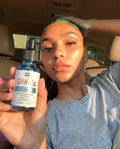
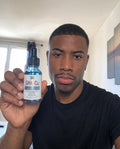
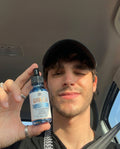
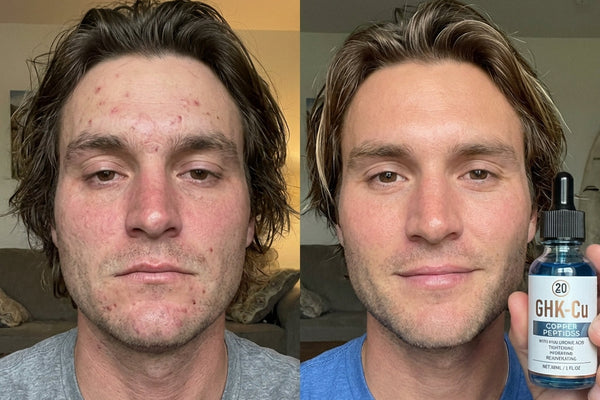
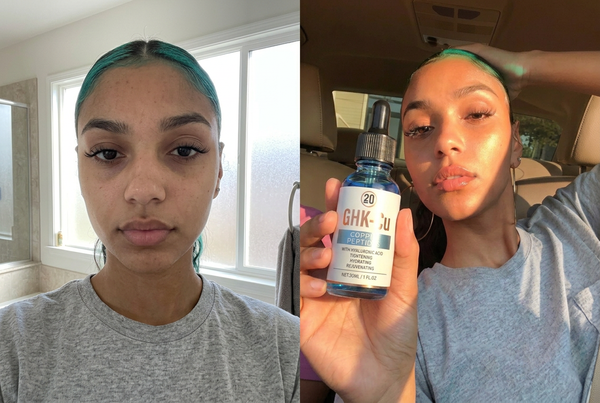
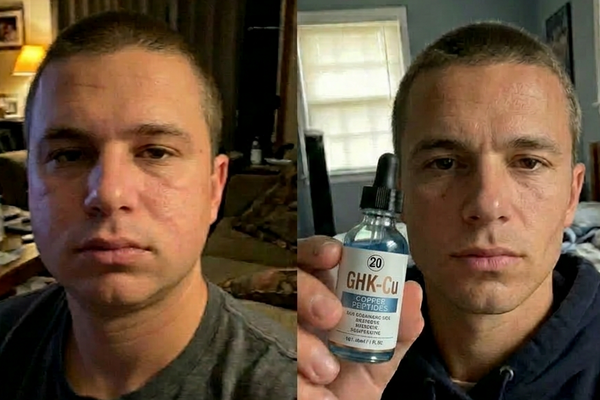
Six ingredients. No fragrance. Nothing you have to look up.
Most serums hide a 30–40 ingredient list behind a "proprietary peptide blend" — code for we won't tell you how little is in here. D20 is six ingredients, every one named, two dosed right on the label. Oil-free. Absorbs in under 60 seconds. No residue, no pilling under SPF or makeup.

The $160 serums charge you for the word, not the dose.
The most expensive copper peptide products on the market — $100, $160, even $300 — frequently include the same ingredient at under 0.5%. You pay luxury-packaging prices for a non-functional dose, then conclude peptides don't work. They do. The dose didn't.
| Factor | Most Brands | Division Twenty |
|---|---|---|
| Copper peptide dose | Often <0.5%, undisclosed | 2% — labeled + visible |
| Transparency | "Proprietary blend," no % | Full list, with concentrations |
| Price / 30mL | $80–$300+ | From $49.99 |
| Formula | Fillers, fragrance, dilution | 6 ingredients, nothing hidden |
| Guarantee | 30 days or none | 90-day money-back |
Week 1 feels different. Week 8 looks different. Week 12 is when people ask.

He used it to prove it was a scam. Then he built the brand.
Evan Carter borrowed his girlfriend's peptide serum for one reason: to disprove it. He was wrong — and what made him angry wasn't that it worked. It was discovering that nearly every product on the market was using a fraction of the studied dose and charging a premium for it.
So he built Division Twenty: 2% copper peptide, six clean ingredients, an honest price, a 90-day guarantee. Not a cosmetics conglomerate — one skeptic tired of the gap between what the research said was possible and what the shelf was selling.

Stop renting results.
Use the dose that was studied.
You've been burned by serums that sounded credible and did nothing. The only question left is whether the next one is labeled, visible, and guaranteed. This one is.
GUARANTEE
Results, or your money back.
Copper peptide results build over 8–12 weeks — so we give you 90 days to reach them. If your skin isn't visibly firmer, smoother, or more defined, send it back for a full refund. Even if the bottle's empty. The dose is real, so the risk is ours.
I've tried copper peptides before and saw nothing.
Is the blue tint dye?
Will it irritate sensitive skin?
Is this for men or women?
How long does a bottle last?
How fast will I see something?

I built this because every other brand was cutting the dose.
Most copper peptide serums stop well below 1% because it's cheaper. I found that out after months of research trying to understand why the whole category underdelivered.
So I built the formula the research actually supports. 2% copper peptide. Nothing compromised.
Judge it by your own face in eight weeks.
One underdosed serum after another costs you another year. The real dose, once a day, costs you nothing to test.