
★★★★★
"Three people asked what I changed. I told them nothing — and I'm happy to gatekeep. I've tried so many serums and most of them do nothing. This one actually made a difference. I'm on my 7th bottle."

Rita S. Elgin, IL ✓ Verified Buyer
For fifty years, research has documented a single compound's ability to rebuild collagen at the cellular level. There's one number on the bottle that decides whether yours can do it — and most brands don't print it on the label. Here's why your last three serums did nothing, and what changes when you find the one dosed correctly.

She left it on the bathroom counter with a sticky note. "Try it. I dare you."
I'm Evan Carter. I'm from Elmhurst, Illinois. I have a brindle French Bulldog named Dutch and a well-documented distrust of any product that costs $80, smells vaguely floral, and makes promises without citing a single source. I'd watched the skincare industry sell my girlfriend increasingly expensive hope for years — serums with beautiful packaging, ingredient names I couldn't verify, and concentrations that were never disclosed.
So I grabbed the bottle. I read the label. I opened three browser tabs on the active ingredient and got ready to build a careful, evidence-based case for why nothing on her counter was actually doing anything.
Six weeks later, I still hadn't given the bottle back.
Not because the marketing won me over. Because the research was more persuasive than anything printed on the box — and when I dug one layer deeper, I found something that made me genuinely angry.
Most brands selling copper peptide serums aren't selling the dose the research studied. They're selling a fraction of it. They've been doing it for years. And the labeling laws in most markets mean their customers have no way to know.

The compound is called GHK-Cu. Copper tripeptide-1. A biochemist named Loren Pickart first isolated it from human blood plasma in 1973 — over fifty years ago — and it's accumulated one of the most substantial research records of any topical cosmetic ingredient in existence. More than seventy peer-reviewed papers. Documented effects on collagen synthesis, elastin production, fibroblast activation, and structural skin repair at the cellular level.
This isn't a new ingredient with exciting early data. It's a fifty-year-old ingredient with a serious body of evidence — the kind that most skincare actives will never accumulate.

So why hadn't it worked for me before? Why hadn't it worked for almost anyone I knew who'd ever tried a copper peptide serum?
The answer was one number that almost no brand discloses.
I spent three weeks going through the published literature. Every study that documented meaningful collagen signaling — the ones with measurable structural results — was working in the 1–2% concentration range. That's the dose the research supports. Below that window, you may get some surface hydration. You are not getting structural change.
Then I went and looked at every copper peptide serum I could find at retail.
Most were formulated at 0.25%. A few mid-range products at 0.5%. Some "professional" formulas advertised up to 1% — but at the lower bound of the therapeutic range, where results are inconsistent at best. Virtually nothing at the full 2%.
The reason is straightforward: copper peptide raw material costs approximately 8× more per unit at 2% concentration than at 0.25%. The formula is significantly more expensive to produce. The margin narrows.
And here is the part that made me angry: in most markets, brands are not legally required to disclose active-ingredient concentration. They only need to list the ingredient name. So a product at 0.25% and a product at 2% can both legally be sold as a "copper peptide serum." Both list GHK-Cu on the label. Both can charge $70 or $80. Only one is dosed to do anything structural.
Your previous serum almost certainly had the ingredient. It just didn't have enough of it. That isn't a personal failing. It's an industry choosing margin over formula, hiding behind labeling that doesn't require them to show their work.
What the market sells versus what the research actually studied. Screenshot this table the next time you're standing in front of a serum aisle.
| Product Category | GHK-Cu Concentration | vs. Research Threshold |
|---|---|---|
| Mass-market serums | 0.25% | ✗ Well below threshold |
| Mid-range peptide serums | 0.5% | ✗ Below threshold |
| Premium / "professional" serums | 0.5–1% | ⚠ At lower bound · inconsistent results |
| Division Twenty | 2% | ✓ Research-backed dose |
Effective concentration data sourced from: Pickart & Margolina (2018); Gorouhi & Maibach (2009); and 70+ published studies on topical GHK-Cu application. Competitor concentration data based on available label disclosures and third-party testing. Most brands do not voluntarily disclose active-ingredient concentration.
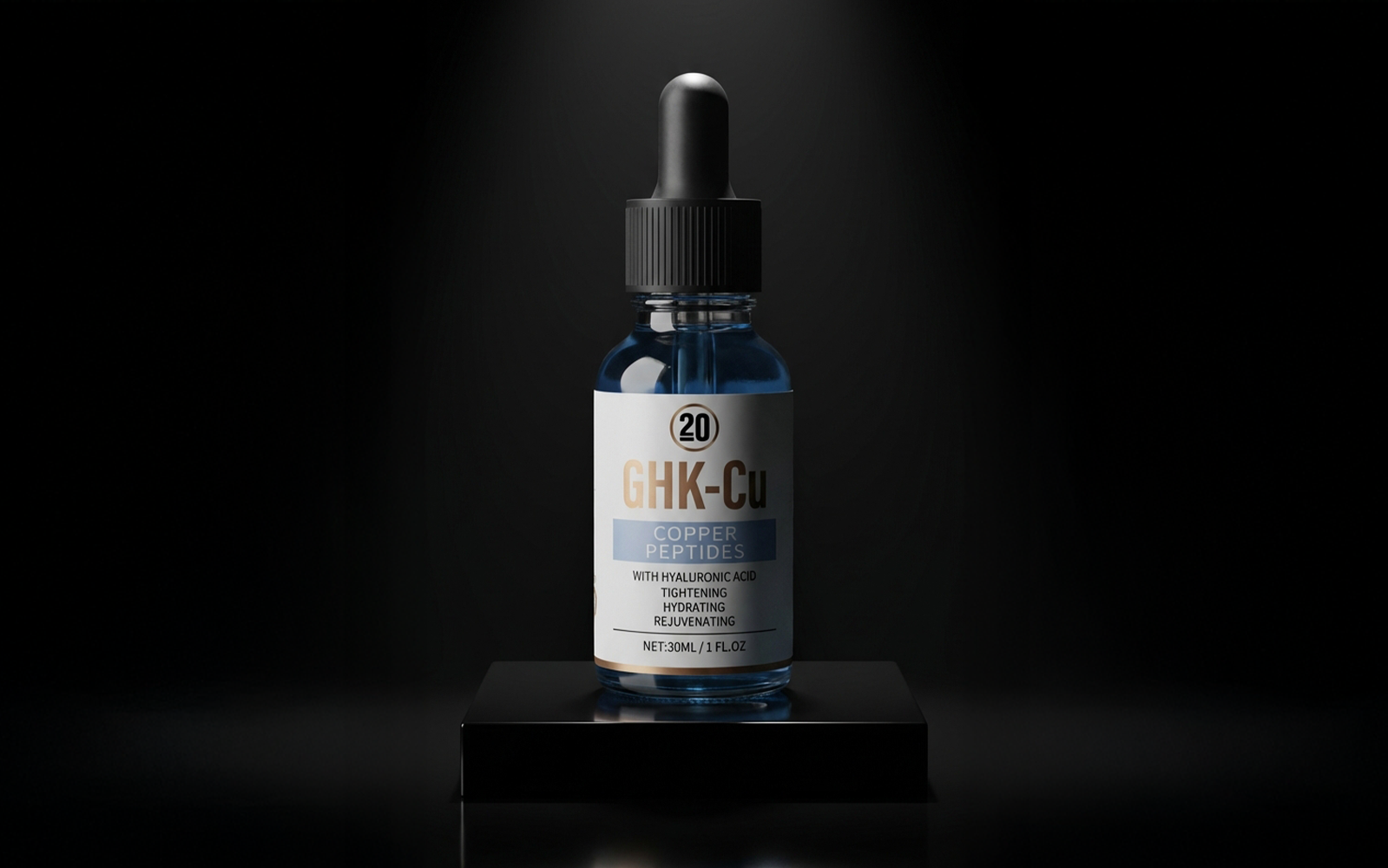
I spent three months going through the actual published studies — the papers themselves, not brand summaries of them. The research was consistent and clear on the effective concentration window. I ordered raw materials. I worked with a cosmetic chemist. I built a formula from the numbers up: 2% GHK-Cu copper peptide complex, paired with 1.5% hyaluronic acid for immediate surface hydration while the structural effects compound underneath.
Then I priced it to be competitive — not to protect a margin built on a formula that quietly uses a quarter of the dose the research studied.
Division Twenty is a small team based in Itasca, Illinois. We ship same day. We back the formula with a 90-day money-back guarantee not as a marketing line, but because we've read the research, we use the product ourselves, and we're confident enough in it to refund anyone who isn't satisfied. If it doesn't work for you, we'll refund you. That's the whole pitch.

2% GHK-Cu copper peptide complex + 1.5% hyaluronic acid. 30mL. Absorbs in 60 seconds. Non-comedogenic. Ships same day.
Try Division Twenty — From $49.99 →Copper peptide serum works structurally, not superficially. Results compound over time. Here's what that actually looks like, week by week.
The hyaluronic acid component works fast. Morning puffiness around the jaw and eyes clears more quickly. Skin feels more comfortable, more hydrated, less dull. You're seeing surface effects. The structural work is beginning underneath — it just takes time to show.
Skin tone evens out. Texture improves visibly. You start fielding questions — "Are you sleeping differently? Did you change something?" You're not entirely sure yourself yet. A month of collagen signaling is producing its first visible outputs, and other people see it first because they're not looking at your face every day.
Firmer-looking skin. More defined contours. Lines that have softened in ways that are hard to attribute to sleep, lighting, or a good angle. This is the structural collagen result — and why the 3-month supply matters. One bottle gets you to week 4, right when it's getting interesting. Three bottles covers the full structural timeline at the lowest cost per bottle we offer.
"I wasn't expecting much — I've tried a lot of serums in the last few years and they all felt like nothing happened. Three months in, my mom told me I was 'glowing.' She doesn't say things like that unprompted. I never write reviews. This one got one out of me."

"Three people asked what I changed. I told them nothing — and I'm happy to gatekeep. I've tried so many serums and most of them do nothing. This one actually made a difference. I'm on my 7th bottle."
"My wife got me using this and I rolled my eyes at first. Three months later I'm the one making sure we don't run out. I'm 51. Works."
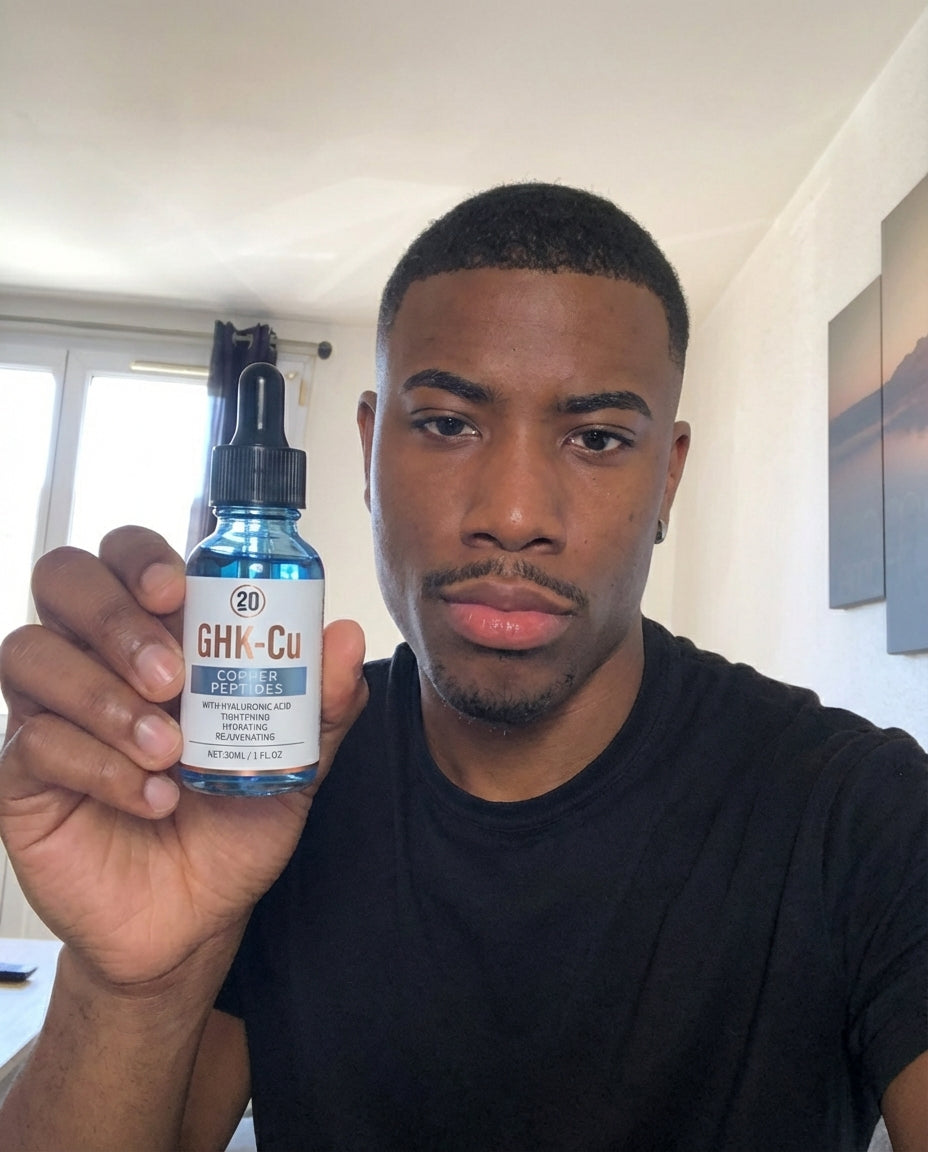
"Not a skincare person at all. Used it for six weeks. My spouse noticed before I did. Skin just looks cleaner, healthier. I can't explain it better than that."

"My jawline looks tighter. Forehead lines are softer. I've spent more than I want to admit on serums over the years. This one actually worked."

One bottle covers weeks 1–4. Three bottles covers the full structural timeline — at the lowest cost per bottle we offer.
Every order ships same day · 90-day money-back guarantee on every bottle · If it doesn't work for you, we'll refund you completely.
That's the most common thing we hear — and it's almost certainly a dose problem, not an ingredient problem. The serums that didn't work were almost certainly formulated at 0.25–0.5%. The research documenting real collagen signaling uses 1–2%. Division Twenty is formulated at the full 2% — the upper end of the therapeutic window. The ingredient works. Most brands just don't use enough of it for any of it to matter.
Honest timeline: surface hydration benefits in the first week, texture and tone improvements around weeks 3–4, and structural firming results in weeks 8–12. Copper peptide serum works at the cellular level — results compound rather than appearing overnight. One bottle gets you into the window where it starts showing. The 3-month supply covers the full structural timeline, which is why most customers don't stop at one bottle.
Yes — but timing matters. Copper peptides and retinol don't play well when applied at the same time. The protocol: serum in the morning, retinol at night. With vitamin C: apply vitamin C first, let it absorb for 5–10 minutes, then apply the serum on top. Sequenced correctly, there's no conflict — they're complementary actives that most customers use together.
All of them. The formula is oil-free, non-comedogenic, and fragrance-free. It absorbs in 60 seconds with no residue. Works on oily, dry, combination, and sensitive skin — including acne-prone. GHK-Cu is naturally anti-inflammatory, which tends to make it one of the few actives that reactive skin types tolerate well rather than react to.
You have 90 days to decide — no forms, no conditions, no small print. Use it consistently for the full timeline. If you don't see results you're satisfied with, email us and we'll refund you completely. We offer this because we're confident in the formula, we use it ourselves, and we're not interested in holding money for a product that didn't perform. Simple.
The serum that didn't work probably had the ingredient. It just didn't have enough of it. The research is 50 years old. The dose that actually works is $49.99.
Try Division Twenty — Start at $49.99 →